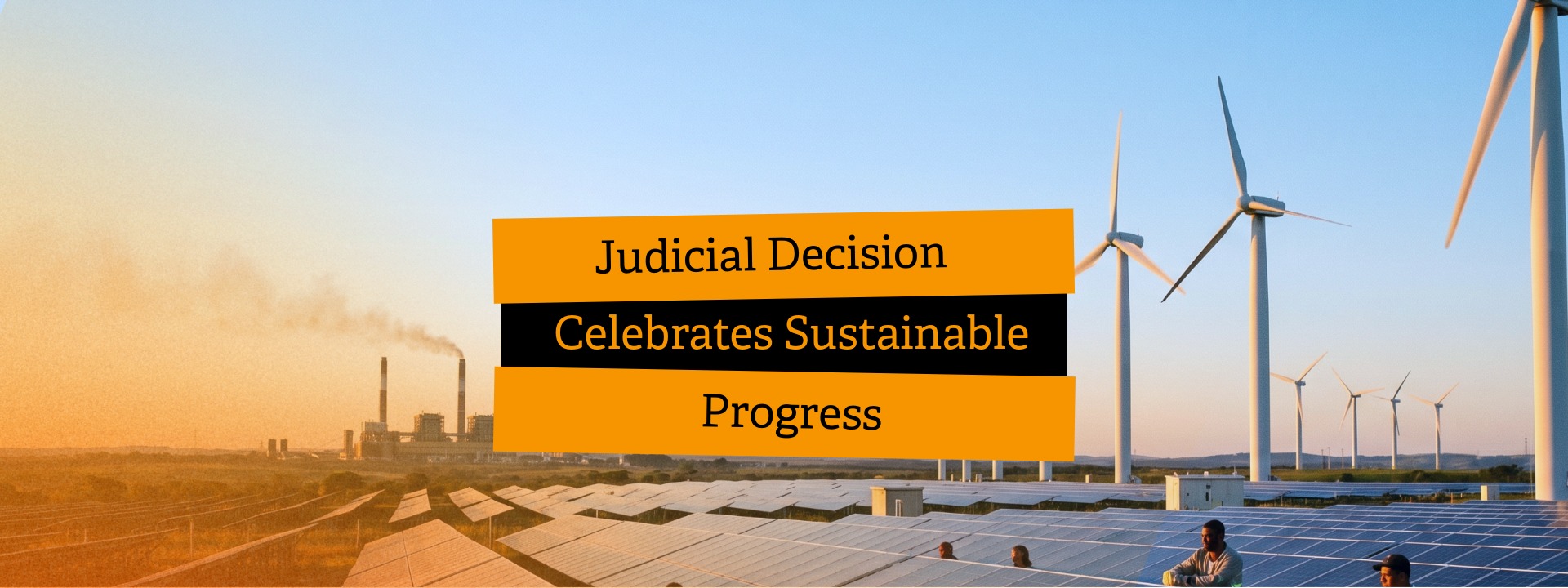
Brazil has just reached a historic milestone in climate and environmental litigation.
In an unprecedented ruling, the Federal Court of Rio Grande do Sul determined that climate impacts and greenhouse gas (GHG) emissions must be formally considered as mandatory criteria in the environmental licensing process for a coal-fired power plant.
The decision was issued in a public civil action filed by the International Institute Arayara against the Candiota III Coal Power Plant, located in southern Brazil, and is widely considered a groundbreaking precedent for environmental licensing in the country.
In practical terms, the ruling establishes that Brazil’s federal environmental agency, IBAMA (Brazilian Institute of Environment and Renewable Natural Resources), cannot automatically renew the plant’s operating license without evaluating the project’s climate impacts, cumulative environmental liabilities, and the need for a decommissioning plan.
What the ruling establishes
The court imposed a series of unprecedented requirements for the renewal of the plant’s environmental license.
Among the main determinations, the ruling requires that:
• specific climate impact assessments be carried out for the operation of the power plant;
• greenhouse gas emissions formally become part of the environmental licensing analysis;
• IBAMA consider the plant’s history of environmental fines, violations, and non-compliance with environmental conditions;
• the company present comprehensive decommissioning plans for all operational phases of the project;
• environmental and climate impacts related to the shutdown of the plant be evaluated;
• the company technically demonstrate its ability to operate within legal air pollution limits.
The decision also states that generic projections will not be sufficient. The company must provide robust technical evidence, operational testing, and concrete proof that the plant can operate without exceeding emission limits for pollutants such as sulfur dioxide and particulate matter.
A new legal and climate paradigm in Brazil
The most innovative aspect of the ruling is the court’s recognition that environmental licensing can no longer be separated from the climate emergency.
Until now, licensing processes for fossil fuel projects in Brazil have largely ignored climate impacts, focusing mostly on local or regional environmental issues.
This decision changes that understanding by formally recognizing that the climate consequences of highly polluting fossil fuel operations must be incorporated into environmental decision-making.
The ruling also references the Advisory Opinion of the Inter-American Court of Human Rights concerning climate change and human rights, reinforcing the understanding that the climate crisis must guide administrative and judicial decisions.
For Nicole Figueiredo, Executive Director of the International Institute Arayara, the decision marks the beginning of a structural transformation in Brazil.
“This ruling establishes a new legal and climate paradigm in Brazil. For the first time, the judiciary recognizes that an environmental license cannot ignore the climate impacts and greenhouse gas emissions of a coal-fired power plant.”
Figueiredo also highlighted that Arayara has long defended the need for fossil fuel projects to include decommissioning plans aligned with the climate commitments assumed by Brazil under international agreements.
The plant’s history of environmental violations
Another central aspect of the case is the recognition of the plant’s extensive environmental non-compliance history.
According to the lawsuit filed by Arayara, environmental fines related to repeated violations of licensing conditions amount to approximately BRL 124.4 million (around USD 22 million). Adjusted for inflation, the total exceeds BRL 235.2 million (approximately USD 41 million).
The court determined that IBAMA must consider this environmental liability before making any decision regarding the renewal of the plant’s operating license.
Juliano Bueno, President of the International Institute Arayara, stated that the case strengthens climate accountability principles in Brazil.
“For years, we demanded that IBAMA verify whether these environmental fines had actually been paid, and this information was never properly presented. The decision recognizes the seriousness of this history of violations and establishes that environmental licenses cannot simply be renewed automatically while environmental and climate liabilities remain unresolved.”
Historic requirement for a decommissioning plan
The ruling also introduces another innovative element: the requirement that the company submit a complete decommissioning plan as a condition for license renewal.
The plan must include:
• a detailed shutdown timeline;
• environmental mitigation measures;
• ecological restoration actions for affected areas;
• assessment of climate impacts associated with the plant’s closure.
This requirement places Brazil closer to international discussions on energy transition, fossil fuel phaseout, and climate accountability.
Why this decision matters internationally
This is considered one of the most important recent climate litigation developments in Brazil because it expands the legal understanding of environmental licensing beyond traditional pollution control and directly incorporates climate obligations into administrative decision-making.
It is also believed to be the first Brazilian court decision to effectively suspend or condition the renewal of a fossil fuel power plant license based on climate arguments and greenhouse gas emissions.
Additionally, the ruling incorporates international human rights and climate standards into domestic environmental law and establishes decommissioning obligations as part of fossil fuel licensing procedures.
Legal experts and climate advocates believe the case could influence future licensing and litigation involving fossil fuel infrastructure across Brazil, including oil and gas projects, thermoelectric plants, and other high-emission activities.
What happens next
IBAMA has until November 5, 2026, to present its final decision to the court regarding the renewal of the operating license for the Candiota III Power Plant.
If the agency fails to comply with the deadline, the ruling establishes a daily fine of BRL 10,000.
More broadly, the case signals a major shift in Brazil’s environmental governance framework: climate impacts are no longer peripheral issues — they are becoming central elements of environmental licensing and judicial oversight.